Why Sheep Grazing on Solar Farms is a Win-Win for Agriculture and Energy
Jul, 01 2026
Many utility-scale solar projects are now expected to deliver more than clean electricity. Developers, landowners, and local communities increasingly want solar farms to preserve agricultural value, reduce operating costs, and improve long-term environmental performance. This is where agrivoltaics has become one of the fastest-growing trends in the solar industry.
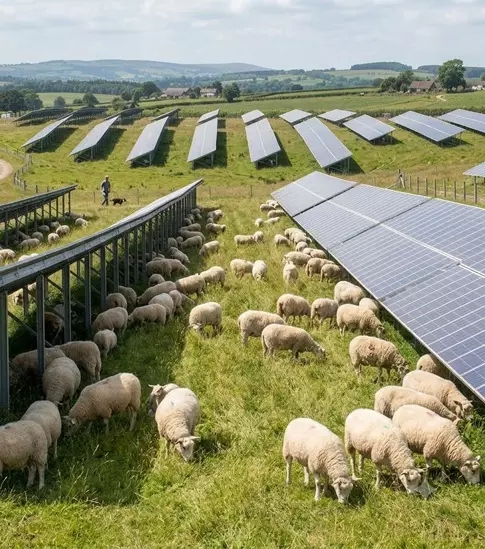
Among different agrivoltaic models, sheep grazing has proven to be one of the easiest and most commercially successful approaches. Instead of leaving land idle beneath solar arrays, sheep naturally control vegetation while continuing agricultural production. The result is a practical solution that benefits both solar developers and farmers without requiring significant changes to existing farming practices.
For EPC contractors and project investors, integrating grazing into solar farms is no longer simply an environmental initiative. It has become a way to reduce maintenance expenses, improve ESG performance, extend equipment reliability, and strengthen relationships with surrounding communities.
Why Are More Solar Farms Choosing Sheep Instead of Mowers?
Vegetation management represents one of the largest recurring maintenance costs throughout the lifetime of a solar power plant. Grass grows continuously throughout the growing season, and unmanaged vegetation can shade PV modules, restrict maintenance access, increase fire risks, and attract unwanted wildlife.
Traditional maintenance usually relies on tractors, ride-on mowers, or herbicides. While effective, these methods require repeated labor, fuel consumption, machinery maintenance, and ongoing operating budgets. For large utility-scale projects covering hundreds or even thousands of acres, vegetation management becomes a substantial operational expense year after year.
Sheep provide a biological alternative. Their grazing naturally maintains vegetation at an appropriate height while producing almost no emissions during operation. Unlike heavy mowing equipment, sheep can safely move between support posts, beneath modules, and around electrical infrastructure without causing soil compaction.
The mounting structure also plays an important role in making grazing practical. A properly designed Ground Solar Mounting Structure provides sufficient clearance for sheep movement, allows maintenance vehicles to access equipment when necessary, and minimizes potential damage to cables and structural components.
Vegetation Management Method
Labor Requirement
Fuel Consumption
Carbon Emissions
Long-Term Cost
Mechanical mowing
High
High
High
High
Herbicide application
Medium
Low
Medium
Medium
Sheep grazing
Low
None
Very Low
Low
Measured Benefits Beyond Grass Control
The advantages of solar grazing extend well beyond reducing mowing frequency. Multiple studies from the U.S. National Renewable Energy Laboratory (NREL), the American Solar Grazing Association, and several European agrivoltaic research programs have shown that integrating livestock into solar farms creates measurable environmental and economic value.
One immediate benefit is lower operating expenditure. Depending on project size and local labor costs, grazing agreements may reduce annual vegetation management expenses by 20% to 40%. Large utility-scale facilities often recover the initial planning effort within only a few operating seasons.
Sheep also contribute to healthier soil conditions. Their movement naturally incorporates organic matter into the ground, while manure returns nutrients that support microbial activity. Better soil quality improves water infiltration, reduces erosion, and encourages native plant diversity beneath the solar array.
Another overlooked advantage involves module operating conditions. Healthy vegetation helps stabilize ground temperatures and reduces excessive dust generation during dry seasons. Cleaner surroundings can reduce soiling on PV modules, supporting more consistent energy production between scheduled cleaning cycles.
Operational Area
Traditional Practice
With Sheep Grazing
Vegetation control
Repeated mowing
Continuous natural grazing
Fuel usage
Diesel equipment
None
Soil condition
Compaction risk
Natural fertilization
Biodiversity
Limited
Improved habitat diversity
Community perception
Neutral
Positive agricultural coexistence
Does Sheep Grazing Affect Solar Power Generation?
This is one of the most common questions asked by project developers. Field experience indicates that properly managed grazing does not reduce electricity generation. In many projects, maintaining vegetation at an appropriate height actually helps prevent shading losses around lower module rows.
Successful projects establish clear grazing schedules, fence layouts, water access, and seasonal stocking densities. These management practices allow livestock operations and solar maintenance teams to work independently without interfering with electrical inspections or preventive maintenance.
Project design remains equally important. Appropriate row spacing, module clearance, drainage planning, and structural stability all influence whether livestock integration is practical throughout the system's 25- to 30-year service life.
Planning a Solar Farm That Supports Livestock
Although sheep are considered one of the easiest livestock species to integrate with PV systems, successful projects begin during the engineering stage rather than after construction. The layout of the array, the choice of mounting system, cable routing, and maintenance access all influence whether grazing can operate efficiently over the next two or three decades.
One of the first design considerations is ground clearance. Most sheep breeds require sufficient space to move comfortably beneath the modules without becoming trapped around braces or electrical equipment. Clearance also allows maintenance teams to inspect foundations, tighten fasteners, and replace damaged components without relocating the animals.
Cable management deserves equal attention. DC cables should be protected inside cable trays or conduit wherever possible. Loose wiring may attract curious animals and can increase the risk of accidental damage during routine grazing activities.
Fencing and water access should also be incorporated into the initial site plan instead of being treated as later additions. Well-positioned gates simplify rotational grazing, while strategically located water stations reduce unnecessary movement across the site and minimize soil disturbance around inverter stations.
Design Factor
Recommended Practice
Reason
Ground clearance
Allow comfortable sheep movement
Improves grazing efficiency
Cable routing
Use trays or conduit
Protects electrical cables
Fence layout
Create rotational grazing zones
Improves pasture management
Water supply
Multiple access locations
Reduces livestock concentration
Maintenance roads
Separate from grazing areas
Safer equipment access
Can Solar Trackers Be Used for Grazing Projects?
Many developers assume grazing is only suitable for fixed-tilt installations, but that is no longer the case. Modern tracker systems are increasingly being designed with livestock compatibility in mind. Proper engineering allows the tracker to rotate freely while maintaining safe distances from animals throughout the day.
A well-designed Horizontal Single Axis Tracker can increase annual energy yield by approximately 15% to 25% compared with conventional fixed-tilt systems, depending on latitude and local irradiation conditions. For utility-scale projects where maximizing energy production is a priority, combining tracking technology with sheep grazing allows operators to improve both electricity generation and land utilization.
The key is selecting tracker systems with sufficient structural rigidity, protected drive components, and carefully planned row spacing. These features reduce maintenance interruptions while giving livestock adequate room to move safely beneath the arrays.
Developers should also coordinate grazing schedules with routine tracker inspections. During annual servicing or actuator replacement, temporary livestock relocation may improve safety for both maintenance personnel and the animals.
System Type
Typical Energy Yield
Land Use Efficiency
Suitable for Sheep
Fixed Tilt
Baseline
High
Excellent
Single Axis Tracker
+15% to +25%
Very High
Excellent with proper design
Dual Axis Tracker
Higher output
Medium
Less common
Operating Cost Comparison Over the Project Lifetime
Vegetation management may appear to be a relatively small operating expense during the first year of a project. However, when evaluated across a typical 30-year service life, recurring mowing costs can become significant. Fuel prices, labor shortages, equipment maintenance, and contractor fees continue to increase in many regions, making alternative maintenance strategies increasingly attractive.
Sheep grazing changes this cost structure. Rather than paying repeatedly for mowing services, many solar farm owners establish long-term agreements with local farmers. Both parties benefit: developers reduce maintenance expenditure while farmers gain access to additional grazing land without purchasing new property.
Cost Category
Mechanical Mowing
Sheep Grazing
Fuel
High
None
Equipment maintenance
High
Minimal
Labor frequency
Frequent
Periodic supervision
Carbon emissions
High
Very Low
Long-term operating cost
Higher
Lower
Illustrative Annual Vegetation Management Cost
Mechanical
Sheep Grazing
The chart illustrates the typical reduction in recurring vegetation management costs after adopting managed sheep grazing. Actual savings depend on labor rates, climate, project size, and grazing agreements.
Best Practices for Long-Term Solar Grazing Success
A successful solar grazing project depends on more than simply introducing sheep after construction. Long-term performance requires coordination between the solar asset owner, the EPC contractor, the grazing operator, and routine maintenance teams. Establishing clear responsibilities from the beginning helps avoid operational conflicts and protects both the photovoltaic equipment and livestock.
Rotational grazing is widely considered the most effective management strategy. Instead of allowing sheep to roam the entire site continuously, the solar farm is divided into several grazing zones. Animals are moved between these areas according to grass growth, seasonal weather, and vegetation height. This approach prevents overgrazing while maintaining consistent vegetation control throughout the project.
Regular inspections should also include checking fence integrity, water availability, cable protection, inverter enclosures, and drainage channels. Preventive maintenance is significantly less expensive than repairing damage after equipment failures or extreme weather events.
Routine Inspection
Recommended Frequency
Main Objective
Vegetation height
Every 2–4 weeks
Avoid panel shading
Fence inspection
Monthly
Prevent livestock escape
Cable protection
Monthly
Reduce electrical risks
Water supply
Weekly
Maintain animal welfare
Structural inspection
Quarterly
Ensure long-term reliability
Selecting the Right Mounting System for Different Projects
Ground-mounted solar farms are the most common choice for agrivoltaic applications, but mounting solutions should always match the project's terrain, climate, and construction requirements. Sites with uneven ground, soft soil, or strict environmental regulations may require different foundation options to balance installation efficiency and long-term structural stability.
For utility-scale grazing projects, fixed ground systems remain the preferred option because they provide wide maintenance corridors and consistent clearance beneath the modules. However, commercial and industrial buildings can also improve land utilization by combining rooftop photovoltaic systems with nearby agricultural operations.
Where roof penetration is restricted, a Ballasted Flat Roof Mounting solution offers an effective alternative. Instead of drilling into the roof structure, ballast provides the necessary stability while helping protect the waterproof layer. This design is commonly used on warehouses, logistics centers, agricultural processing facilities, and industrial buildings where preserving roof integrity is a priority.
Project Type
Recommended Mounting Solution
Typical Application
Utility-scale solar farm
Ground-mounted system
Agrivoltaics and livestock grazing
Commercial warehouse
Ballasted flat roof system
No roof penetration required
Agricultural facility
Ground or rooftop system
Mixed energy production
Industrial complex
Fixed tilt or tracker
Maximum electricity generation
Frequently Asked Questions
Will sheep damage solar panels?
In normal operating conditions, sheep rarely damage PV modules or mounting structures. Unlike cattle or horses, sheep are lightweight and do not climb onto the support structure. Proper cable management and secure fencing further reduce operational risks.
Which sheep breeds are commonly used?
Many projects use breeds such as Dorset, Suffolk, Katahdin, and Texel because they adapt well to grazing beneath solar arrays. Breed selection should always consider regional climate, vegetation type, and local farming practices.
Does grazing reduce maintenance work?
Yes, but it does not eliminate maintenance completely. Vegetation management becomes significantly easier, while routine electrical inspections, structural checks, module cleaning, and inverter servicing remain part of normal solar plant operation.
Can agrivoltaics improve project sustainability?
Yes. By producing renewable electricity while maintaining agricultural activity, agrivoltaic systems improve land-use efficiency and support environmental objectives. Many developers also report stronger community acceptance because farmland continues to serve an agricultural purpose instead of being removed entirely from production.
Are you preparing for a utility-scale solar project? We provide technical consulting and structural support to ensure your assets are built on a solid foundation.
Ready to start your next project? Contact us at: fred@sunnect-solar.com