How to prevent rust at weld points on galvanized solar mounting structures
May, 06 2026
This is a comprehensive guide to Corrosion Protection for Welded Galvanized Steel Structures. When galvanized steel is welded, the intense heat consumes the protective zinc layer, leaving the steel exposed to the atmosphere. If left untreated, these weld joints become the "weakest link," leading to premature structural failure.
Technical Guide: Corrosion Protection for Welded Galvanized Steel Joints
In industrial and solar mounting applications, galvanized square steel is a standard material choice. However, the welding process is inherently destructive to the protective zinc coating. To maintain a 25-year structural lifespan, you must implement a systematic post-weld restoration process.
1. Pre-Weld Preparation: The Foundation
Effective corrosion prevention begins before the torch is lit.
Localized Dezincification: Before welding, grind away the galvanized layer approximately 20–30 mm on both sides of the joint using an angle grinder or abrasive paper.
The Logic:
Health: Prevents the inhalation of toxic zinc fumes during welding.
Weld Quality: Molten zinc can mix into the weld pool, causing porosity, brittleness, and cracking. Removing it ensures a clean, high-strength structural bond.
2. The Five-Step Post-Weld Restoration Strategy
Restoring the protection is a precise, multi-layered chemical and mechanical process.
Step 1: Cleaning and Decontamination
Welding slag, spatter, and oxidation are highly corrosive and must be fully removed.
Mechanical Removal: Use a wire brush or angle grinder to expose bright, clean metal.
Solvent Degreasing: Wipe the area with alcohol or a professional metal cleaner. Residual oil or hand sweat can cause the paint to delaminate, rendering the repair useless.
Step 2: Restoring Cathodic Protection (The Zinc Layer)
This is the most critical step. You must restore the "sacrificial" protection that makes galvanized steel so effective.
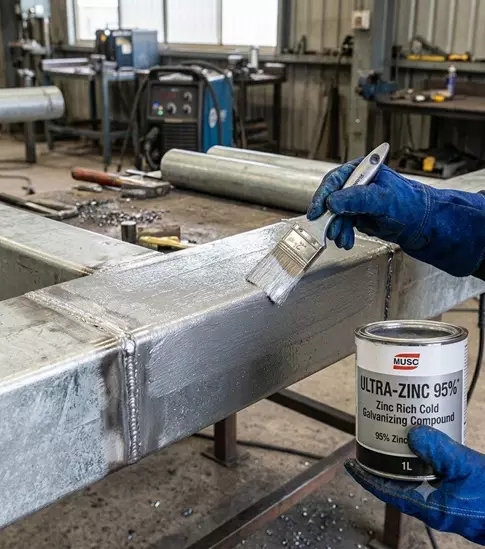
Cold Galvanizing Compound: Apply a high-quality cold-galvanizing paint with a zinc content of $\ge$ 92% in the dry film.
Application: Apply 2–3 layers, allowing 30 minutes of flash-off time between coats. Unlike decorative silver paints, true cold galvanizing provides active cathodic protection, meaning the zinc will corrode instead of the steel.
Step 3: Enhancing the Barrier (Epoxy Zinc-Rich Primer)
Once the zinc layer has cured, apply an epoxy zinc-rich primer ($\ge$ 80% zinc content). This layer serves as a high-density chemical barrier that seals the weld and prevents moisture from reaching the base metal.
Step 4: Weatherproof Topcoating
The zinc-rich primer protects against rust, but it is often vulnerable to UV and mechanical wear.
Acrylic Polyurethane Topcoat: Apply 1–2 coats of a UV-resistant topcoat. This provides a durable, chemical-resistant shield that protects the primer from environmental degradation.
Aesthetics: Choose a finish—typically silver-gray—to ensure the repaired joint blends seamlessly with the rest of the structure.
Step 5: Auxiliary Sealing (For Severe Environments)
For structures in coastal, high-salinity, or underground environments, standard painting may be insufficient.
Heat-Shrinkable Sleeves: For pipe joints, use a heat-shrinkable sleeve with hot-melt adhesive. This creates an airtight, physical seal that is impervious to moisture.
Anti-Rust Wax: For intricate crevices or joints that cannot be easily painted, inject anti-rust wax. This displaces moisture and stays flexible, providing long-term protection in hard-to-reach areas.
3. Quality Assurance and Maintenance
To guarantee a 25-year service life, you must manage the assets proactively.
Environmental Adaptation: In "salt-fog" or high-humidity environments, increase the total Dry Film Thickness (DFT) and consider upgrading to high-performance fluorocarbon topcoats for superior chemical resistance.
Routine Inspection: Treat weld joints as critical infrastructure. Inspect coatings every 1–2 years. If mechanical damage (scratches or chips) occurs, perform a "spot touch-up" immediately to prevent rust-creep under the remaining paint.
Safety Standards: Always ensure workers wear proper respirators rated for metal fumes and use adequate ventilation, especially in confined spaces.
Conclusion
Post-weld rust prevention is not merely "touch-up painting"; it is the reconstruction of an electrochemical protection system. By strictly controlling surface preparation, applying high-zinc compounds, and sealing the joint with a weatherproof barrier, you ensure your project remains structurally sound and visually pristine for decades.
Are you planning a project that requires long-term structural durability?
We provide expert guidance on material selection and corrosion mitigation for solar, commercial, and industrial steel structures.
Contact us at: fred@sunnect-solar.com