Mini Rails vs. Long Rails: Engineering the Right Solar Roof Architecture
Aug, 28 2026
The mounting structure represents the second-largest driver of embodied carbon in a solar PV system. Selecting between short, segmented profiles and continuous long rails is not a mere installation footnote; it is a fundamental engineering and commercial decision.
Every solar deployment begins with this critical structural choice. Before specifying inverters or configuring cable runs, the mechanical interface with the roof must be established. The market is defined by two primary solutions: continuous horizontal rails and localized mini rails. They are not interchangeable, and the distinction dictates structural load paths, supply chain efficiency, and project margins.
The Mechanics of Mini Rails
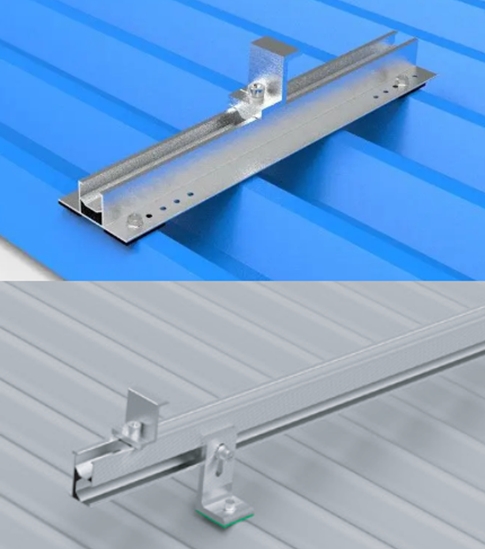
Mini rails are compact aluminum extrusions, typically spanning 250 mm to 600 mm. Rather than deploying full-length continuous tracks across a roofspan, installers position two targeted profiles beneath each module—securing the top and bottom edges prior to final clamping.
Optimal Application Engineered specifically for trapezoidal and corrugated metal roof sheets, these components anchor directly into the roof crest. They utilize self-drilling fasteners integrated with EPDM rubber backing, which instantly compresses to form a robust, weatherproof seal. This localized approach eliminates the need to locate underlying purlins or navigate complex roof flashing.
Advantages:
Material Efficiency: Achieves a 30–50% reduction in aluminum mass compared to continuous baseline systems.
Commercial Viability: Delivers 25–40% lower overall project costs when factoring in material CAPEX, labor, and logistics.
Logistical Optimization: Compact palletization maximizes shipping container density, allowing a standard commercial van to transport volumes that would otherwise require a flatbed truck.
Agility: Lightweight design facilitates rapid deployment, often requiring only a single installer for smaller capacities.
Limitations:
Load Distribution: Concentrates structural forces into point loads rather than dispersing them across a continuous beam.
Environmental Variables: High-wind environments necessitate a higher density of localized fixings per module, which can incrementally offset initial material savings.
Roof Compatibility: Strictly incompatible with non-structural roof skins such as tile, slate, or flat membrane surfaces.
The Mechanics of Continuous Long Rails
Continuous long rails represent the traditional PV mounting architecture: full-length horizontal aluminum tracks aligned parallel to the roofline. Acting as primary structural beams, these extrusions distribute module weight and aerodynamic forces along their entire span, systematically transferring the load down into the building’s core structure through periodic anchor points.
Optimal Application Long rails are the definitive engineering solution for tile, slate, flat membrane, and standing-seam profiles. They are mandatory for high-load environments, including aggressive snow zones, exposed coastal sites, and hurricane-rated geographies. Whether utilizing roof hooks that reach the structural rafters on a slate roof or non-penetrating clamps on a standing seam, the mechanical load path always terminates at the building's structural timber or steel, bypassing the outer roof covering entirely.
Advantages:
Structural Integrity: The beam action effectively neutralizes localized point loads, smoothing out dynamic forces.
Load Dispersal: Ensures uniform weight distribution across multiple structural members, a critical requirement when calculating against severe snow loads or wind uplift frameworks.
Installation Tolerance: Highly forgiving of minor roof irregularities, permitting modules to slide laterally along the extrusion for precise coplanar alignment prior to final torqueing.
Limitations:
Logistical Footprint: The bulky extrusions demand longer transit vehicles, increased shipping cycles, and higher freight overheads.
Cost & Carbon: Drives up the baseline material CAPEX and embodied carbon per installed kWp.
Deployment Velocity: Slower to install, typically mandating multi-person crews for maneuverability.
Comparative Specification Matrix
Specification
Mini Rails (Segmented Profiles)
Continuous Long Rails
Optimal Roof Architecture
Trapezoidal & corrugated metal
Tile, slate, flat, standing seam
Mechanical Fastening
Self-drilling screws with EPDM sealing into roof crests
Roof hooks or structural brackets anchored to rafters
Aluminum Footprint (per kWp)
30–50% reduction
Industry baseline
Overall Project CAPEX
25–40% reduction
Industry baseline
Extreme Wind & Snow Loads
Requires augmented fastener density
Native structural suitability
Deployment Crew
Frequently single-operator
Multi-person requirement
The Carbon and Logistical Nexus
Beyond the photovoltaic modules themselves, the aluminum mounting structure is the second-largest driver of embodied carbon within a rooftop array. While this metric may not appear on standard commercial quotations, it is a glaring variable in any formal lifecycle assessment (LCA).
The root cause is the raw material. Primary aluminum smelting is one of the most energy-intensive industrial operations globally, consuming roughly 14 to 16 megawatt-hours of electricity per tonne. Even when powered by hydroelectricity, the carbon intensity of finished extrusions remains high; if coal-powered, the environmental toll is severe.
This makes mini rails the definitive eco-efficient solution for standard metal roofs. Achieving a 30–50% reduction in aluminum mass translates directly to a proportional drop in upfront embodied carbon. Furthermore, the compact pallet footprint drastically optimizes shipping container density, directly mitigating the Scope 3 transport emissions—and volatile freight overheads—associated with moving the hardware from the manufacturing facility to the installation site.
However, continuous long rails are structurally essential for incompatible roof skins or extreme load environments; substituting them in these scenarios compromises safety. The core issue is not the existence of long rails, but the industry habit of defaulting to them on standard trapezoidal metal structures where mini rails could achieve the same mechanical threshold with half the material. Every kilogram of aluminum optimized out of a system design is a kilogram saved from the smelter.
Strategic Deployment Criteria
There is no universal solution, nor should there be. Mini rails and continuous rails are complementary architectures, with their deployment dictated by structural engineering frameworks, geography, and environmental targets:
Metal roof, moderate load climate: Mini rails, almost exclusively.
Tile, slate, membrane, or standing seam: Continuous long rails, without exception.
Exposed, high-wind, or heavy-snow sites: Continuous long rails, regardless of the underlying roof skin.
Marginal or mixed conditions: Dictated by strict structural calculation, not catalog default.
A competent engineering and installation team makes this selection deliberately on every project rather than relying on standard inventory habits. For environmentally and financially conscious procurement, the baseline question is: "Can this array be securely mounted using mini rails?" When the technical answer is yes, the low-carbon option aligns perfectly with the most cost-effective solution.
Executive Summary
The structural framework is the second-largest source of embodied carbon in rooftop solar. Mini rails minimize the aluminum footprint and localize loads across multiple point fixings, while continuous long rails act as spanning beams to disperse heavy loads and accommodate irregular roof battens. The definitive choice must always be driven by the roof's mechanical capacity and environmental load parameters.
Are you preparing for a solar project?
We provide technical consulting and structural support to ensure your assets are built on a solid foundation.
Contact us at: fred@sunnect-solar.com